


In a letter to Walter Benjamin from Jerusalem in 1934, Gershom Scholem included a poem he had written about the relationship between Kafka’s The Trial and Jewish mysticism. In it he writes, “No life can unfold/ That doesn’t sink into itself.” What does this mean? To say anything certain about the Kabbalah, or even Kafka, is not easy. A life sinking into itself suggests a contraction or reduction, a form of loss in which, perhaps, one becomes their more essential self. Facing my own confusions, I’ve often wondered: How do we discover this self? That is, when a life sinks into itself, where is it sinking? Presumably, Scholem’s lines suggest, into the space from which it will then unfold. But how might this procedure occur? A folded thing is already complete, was never in fact incomplete, its shape, its always immanent form, was simply hidden by the small glimpse of what we could see.
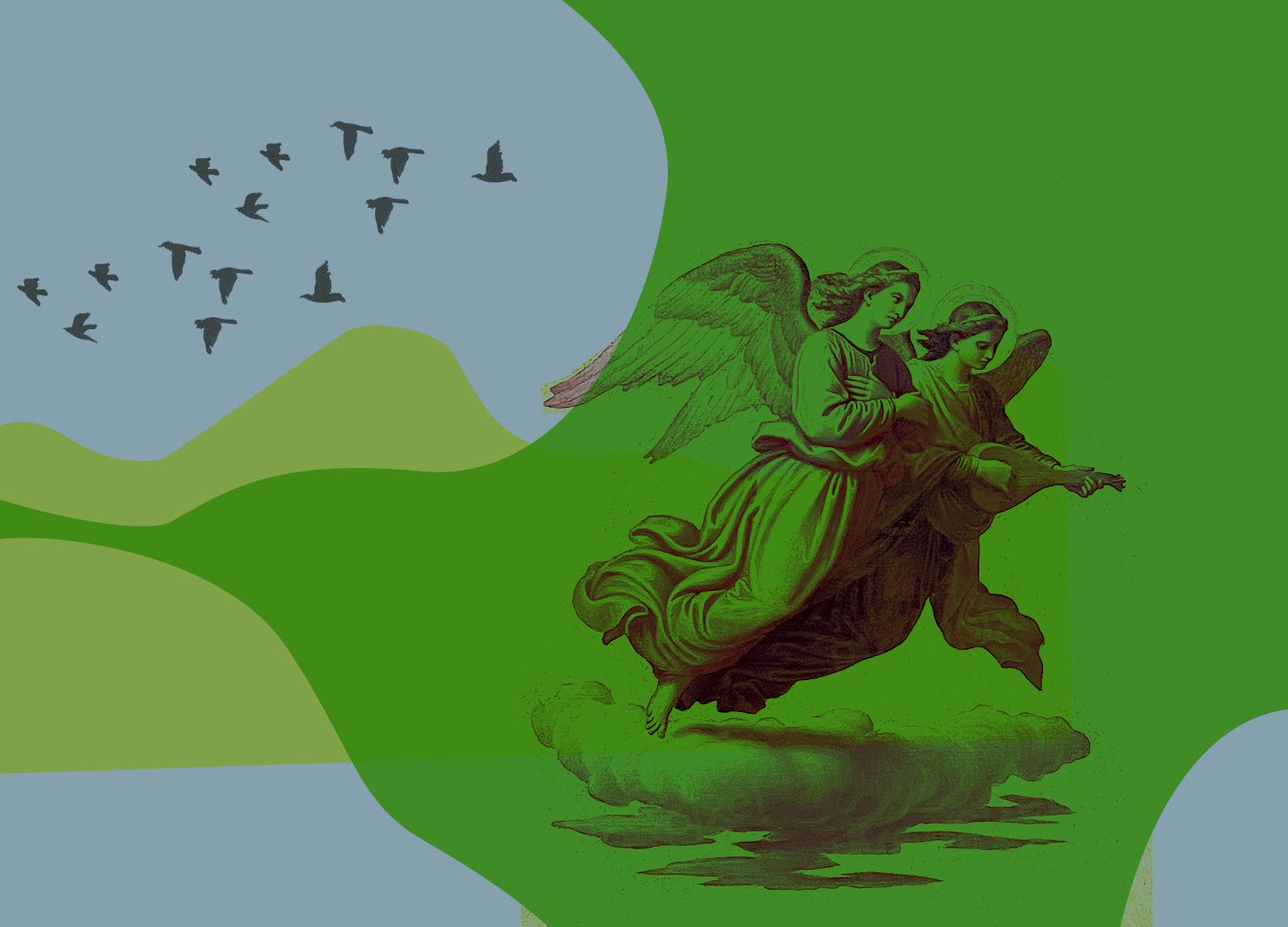
The unfolding life, the life unfolding from this disguised self, is the place we make art from, flourish from; it is the hidden shape our flourishing was always going to take. My question here is, I think, one of Kafka’s questions: can we ever apprehend a meaningful life? According to Scholem there is a Talmudic tradition in which “the personal angel of each human being … represents the latter’s secret self and whose name nevertheless remains hidden from him … This angel, to be sure, can also enter into opposition to … the earthly creature to whom he is attached.” So, whoever we are—and we are someone! We have a secret self! We have a way we should be living!—we will remain mysterious to ourselves. Bleak, but no surprise: who among us has lived as we wished? That is, we can’t take our unfolding, which occurs almost exclusively in the future, for granted, and to encounter our angel, our secret self, is never easy: it shimmers with accusation, protest, catastrophe.
Once, about a decade ago, I was living in a cottage in Maine, on the ocean. Every morning, I went down to a fish house to write, I walked on the shore, I discovered the leg of a deer severed at the knee on the rocks, I was chased by birds. This kept happening: I found deer legs on different beaches, ospreys, everywhere, assaulted me. To live on the sea is to orient yourself to signs—wind and tides, lunar moods, swift shoals of fish. But what did any of this mean? This was a season when I was suspended on the edge of my own desire: I was about thirty, I had recently published a novel, I had a job as a professor of creative writing, a beautiful girlfriend and a cat, an apartment in the city full of light. But everything was contingent, the job especially, and though I felt that I was living the life I had always imagined living, it also felt vaporous, in doubt, a mirage. I thought often of Kafka’s unpublished story, “The Great Swimmer,” in which a man returns to his hometown to find that he is a hero: apparently he has set a world record in swimming at the Olympics in Antwerp. He is met at the station by an adoring throng, he is hailed and garlanded and taken to a feast in his honor. The only problem is that he can’t swim. He has always wanted to learn how, but never managed. This isn’t a case of mistaken identity—he is indeed the person who broke the record in swimming. But he doesn’t know how he did it, or even why anyone would have asked him, a man who can’t swim, to swim in the Olympics.
The Great Swimmer’s experience of his own success is uncanny. (In fact, he begins to realize that he can’t understand the language spoken in his hometown). This is a recognizable sensation for a writer. That summer on the shore: I had published my first novel, but writing the book, the part of it that was mine, was already years in the past. Publishing was a public act, external to me, separate from me. Although it was supposed to be the culmination of my desire, once in the world the real and legible object seemed fraudulent, an embarrassing pastiche of achievement, empty of, or just separate from, anything I’d ever wanted. Meanwhile, the safety I had imagined this accomplishment—publishing a book—producing, the sense of rightness or certainty that I was living as I should be, had not materialized. No steady employment had appeared. My girlfriend asked sane questions about the future. We drank too much. We played Billie Holiday at manic hours. We were still afraid. Finally, I fled to the coast. I walked on the beach. I lived alone. Everywhere signs of threat: deer legs mangled on the shore. Easily offended raptors. I knew the schedule of tides. The fog hid nothing from me. My life had sunk into itself, but as it started to unfold it no longer seemed to express the shape it had suggested. That is: it unfolded, it looked like the unfolded thing was supposed to look, as I had imagined it, more or less—but it didn’t seem to contain the flourishing.
“The Great Swimmer” is a story in which the shape of the protagonist’s accomplishment does not represent any parallel feeling. The achievement, unfolded for all to see, occurred but remains unreal, devoid of its substance. In this way it is a story about satisfaction, or what satisfaction feels like, which isn’t, no matter the quality of the satisfaction, how we imagined satisfaction feeling. Adam Phillips writes that “[i]magining satisfaction is a way of not thinking about wanting, not thinking about the experience of wanting.” This makes sense to me. It’s painful to want something; to acknowledge desire is also to acknowledge the possibility that the desire may not be satisfied. According to Phillips, our fantasies of satisfaction protect us from these vulnerabilities. Consequently, satisfaction, if it occurs, feels unreal and unearned. In “The Great Swimmer” Kafka has literalized this process: his swimmer is so estranged from his own wanting and his own achievement that he cannot recognize himself as a swimmer at all and cannot speak the language in which praise is offered to him. He is adrift, an outcast from his own longing. He might wish to sink into himself, but sinking is not something a great swimmer can do.
Early in his diary Kafka expresses a similar frustration. After writing a jingle about despair and musing over the desire (it seems) to go to a brothel, he returns to the problem at hand: “at last after five months of my life in which nothing I wrote could satisfy me and for which no power will compensate me, though all be obligated to do so, it occurs to me to speak to myself once again.” I wonder what kind of satisfaction Kafka is seeking here? I’m serious. Even people who know almost nothing about Kafka know that his writing didn’t satisfy him. But imagine being Kafka and not being satisfied by your writing? The problem must be with satisfaction, or the idea of satisfaction, not with Kafka. If our imagined satisfactions are, as Phillips posits, fantasies of fulfilled desire that protect us (we hope) from the pain of actual wanting, then whatever satisfaction is, it is not something a writer (who must endure the difficulties of fulfillment) may experience. No wonder Kafka wanted to go to the brothel! The pleasures writing might offer are the opposite of going to a brothel—that space operating according to the logic of fantasy—where, with no effort, no possibility of rejection, the desired outcome remains certain. Phillips, riffing on Cavell and Winnicott, thinking about Lear, writes that, “It is worth wondering what happens to our erotic life, or to our sociability with each other and ourselves, when certainty becomes our picture of satisfaction.”
That season on the shore all my fantasies were about certainty. I had everything I wanted—a novel! A job! Love!—but had no idea how to hold on to any of them. I was like the narrator of Kafka’s story, “The Burrow,” describing the safe home he has built for himself underground: “it is secured as safely as anything in this world can be secured; yet somebody could step on the moss … and destroy everything for good.” Security, safety, certainty—all, in the space of a semicolon, give way to possible loss. Thinking back on those years, I encounter some mix of shame and tenderness for how sincerely we searched for a shape to hang our longing on. Buying a house, starting a family, recognizing the life we were living as the life we wanted—my own contingencies and failures had made those things impossible. In the meantime, the world was full of threat and omens. I walked on the beach. Again and again, I came across the severed legs of deer. Enraged ospreys. I spoke to my girlfriend over bad phone lines, floods of static and wind. She was mumbling or weeping. She said she would visit or wouldn’t. Our lives would start or wouldn’t. I knew bad things would happen to us and they did. The cove faced west. Nightly the sun melted over the sea in ludicrous spectrums. My dread was dense with awe. “[I]t occurs to me to speak to myself once again.” These were days, I should mention, when I drank a little of everything.
One evening, with a storm coming, I walked down to the tavern at Land’s End. The bartender spoke only about the weather. Her boyfriend was a lobsterman, animals followed him everywhere, birds and seals, then dogs and rodents, clouds of flies. “What do you do during the winter?” I asked. Two beers, two scotches, a disastrous glass of blueberry wine. Like the characters in Kafka’s parables, I never said the right thing. In the tavern that night, there were a couple of Passamaquoddy guys down from Pleasant Point. They were talking about shooting eagles on the reservation and selling kebabs to tourists. I bought everyone a round of Geary’s. One of the Passamaquoddy men had married an Irish woman from Boston. How he convinced her to live on the reservation up near Canada was the only question anyone could ask. “Before she said yes I only let her visit in the summer.” I wanted to know what eagle tasted like. I have never not let myself be lied to, I will believe anything in a bar. I wanted one certainty. “A little like loon,” said one of the men.
Scholem’s poem about Kafka and the Kabbalah continues: “From the center of destruction/ A ray breaks through at times,/ But none shows the direction/ The Law ordered us to take.” Scholem is not a poet and he intends his poem to function didactically, but even the most concrete expression, turned into poetry, requires interpretation. Beneath the obvious object (plums in an icebox, a red wheelbarrow) glows the hazy light of another meaning, simultaneously immanent and unknown. This is exactly the problem Scholem is trying to explain about Kafka’s work. For him, Kafka’s representation of a visible, though illegible, Law reproduces the impossibility of apprehending divine immanence as expressed in the Kabbalah.
In his “Ten Non-historical Statements” Scholem writes: “The Kabbalist states that there is a tradition concerning truth and that that tradition can be transmitted. It is an ironic statement, for the truth in question here has all sorts of properties, but certainly not that of being transmissible.” This is to say, returning to where we started, that meaning exists and can unfold into the recognizable, apprehensible, world; but what is then recognized, or apprehended, no longer contains the original meaning. For instance, you might say that a definitive feature of a ray of light is that it is a ray, a line, it points at something, but the immanent truth the ray in the poem points at, once indicated, can no longer be understood. We crave revelation, but what does revelation reveal? Only perhaps what cannot be revealed.
That night in the bar, the storm hit and the power went out and the emergency LED lights sizzled on, glowing in blue illuminated strips from the rafter above the bottles. Kafka evoked a similar image in his journal in June of 1914. A man is in his room when a bluish, violet light appears on the ceiling. As in Scholem’s poem, the light renders the secret world briefly visible: “the ceiling of the room didn’t actually change color, the colors only made it somehow transparent, above it there seemed to be things hovering that wanted to break through … an arm was stretched out, a silver sword hovered up and down.” The man imagines that this incomplete form, appearing out of an eerie luminescence, has been sent there for him and he tears out the electric light to make room for it to “announce to me what it had to announce.” The ceiling breaks open and “an angel in bluish violet robes … descended slowly in the semidarkness … the sword in its upraised arm stretched out horizontally. ‘So it’s an angel!’ I thought ‘all day it’s been flying towards me and in my unbelief I didn’t know it. Now it will speak to me.’” He readies himself for its revelation, he looks down, and then when he looks back up,
although the angel was still there, hanging quite low under the ceiling, which had closed up again, it was not a living angel, but only a painted wooden figure from the prow of a ship, such as hang from the ceiling in sailors’ taverns. Nothing more. The pommel of the sword was made to hold candles and catch the flowing tallow. I had yanked down the electric light, I didn’t want to remain in the dark…so I climbed onto a chair, stuck the candle into the sword pommel, lit it and then sat far into the night under the weak light of the angel.
Although Scholem would not have known this scene when he composed his poem, it strikes me now as a perfect corollary to it. The word for angel in Hebrew is malakh, messenger. They carry the divine news. But once the narrator sees the messenger, coming to announce what it had to announce, his sight reduces it to a garish tchotchke for candles, poorly replacing whatever light he had before. Its form still suggests significance: after all, a ship’s figurehead leads the way, points toward a destination, but this figurehead has been separated from its ship, is now an arrow indicating nothing; the angelic light, the ray issuing from the catastrophe, is gone, replaced with the frail terrestrial gutter of a few candles.
Surely Kafka also intended this as an allegory for what it feels like to make art: we sense some inchoate pulse from realms beyond ourselves but intended for us, and once we wrestle it into the world, into form, it is deprived of the shimmer we at first perceived. Of course, I don’t believe this of my own work, let alone Kafka’s. The form is the meaning. And to live this way? Trying to dig the riverbed before the deluge? I suppose it’s as confusing as anything else. There’s no law that we must be satisfied. The light Kafka sat under, weak as it was, so much less numinous than he hoped, was the light he lit. Scholem’s angels might testify to a name we can’t find syllables for, but it is our own.
After the rain stopped and the Passamaquoddy guys left, the bartender began to cry. “Loon,” I said to her, “can you believe it?” Eventually, their story had changed: they sold loon kebabs to tourists and told them they were eagle. What does loon taste like was a question I barely knew better than to ask. Of course, there were no tourists on Pleasant Point. Nobody anywhere was eating loon. Would it be too symmetrical to say that just then, out on the midnight tide, two loons began to call to each other through the new mist? Because that’s what I remember, though it was late in the season and they should already have flown inland. They called and called and I arrived, bearing my own message, back at the first time I’d ever heard them as a boy camping in New Hampshire, drawn out of sleep by a dream of wolves who turned into birds no less wonderful when I woke.
Quotations from the following sources:
Franz Kafka, “The Burrow,” trans. Willa and Edwin Muir. Collected Stories (Knopf).
Franz Kafka, Diaries, trans. Ross Benjamin (Shocken).
Franz Kafka, “The Great Swimmer,” trans. Daniel Slager. (Grand Street no. 56, Spring 1996).
Adam Phillips, Missing Out: In Praise of the Unlived Life (FSG).
Gershom Scholem ed, The Correspondence of Walter Benjamin and Gershom Scholem (Shocken).
Gershom Scholem, “Ten Non-historical Statements.” Judaica 3 (As cited by Stéphane Mosès in The Angel of History: Rosenzweig, Benjamin, Scholem, trans. Barbara Harshav (Stanford University Press).
Gershom Scholem, “Walter Benjamin and his Angel.” Jews & Judaism in Crisis (Shocken).
 | A guest post by
|
Goddamn. Also: a brilliant, illuminating companion to THE TAVERN AT THE END OF HISTORY.
Just read this quickly and want to read it again more slowly, but enjoyed it a lot. Kafka really is a religious writer, sort of like Beckett is a religious writer, but more so. The angel reminds me of Wings of Desire and a short story by Nabokov, "Wingstroke." Wondering why we go on believing in angels when skeptical about the rest of religion as I am now?