


Editors’ Note: In the coming weeks, we’ll begin publishing Kafka’s first letters to Max Brod as part of Ross Benjamin’s ongoing translation project. To mark the occasion, we asked Elif Batuman for permission to share her write-up of the brilliant talk she gave on Kafka and Brod at the Kafka 100 conference in Prague in June 2024—later published on her Substack. She generously agreed, and we’re delighted to present it here. For more from Elif Batuman, subscribe to The Elif Life—we can’t recommend it highly enough.
Loyal readers! As promised last time, here is a write-up of the talk I gave at a Kafka conference in Prague—about the Kafka-Brod collaboration in work and in life. I’ve included the original slides, plus a few new images and links.
Thanks for your support!
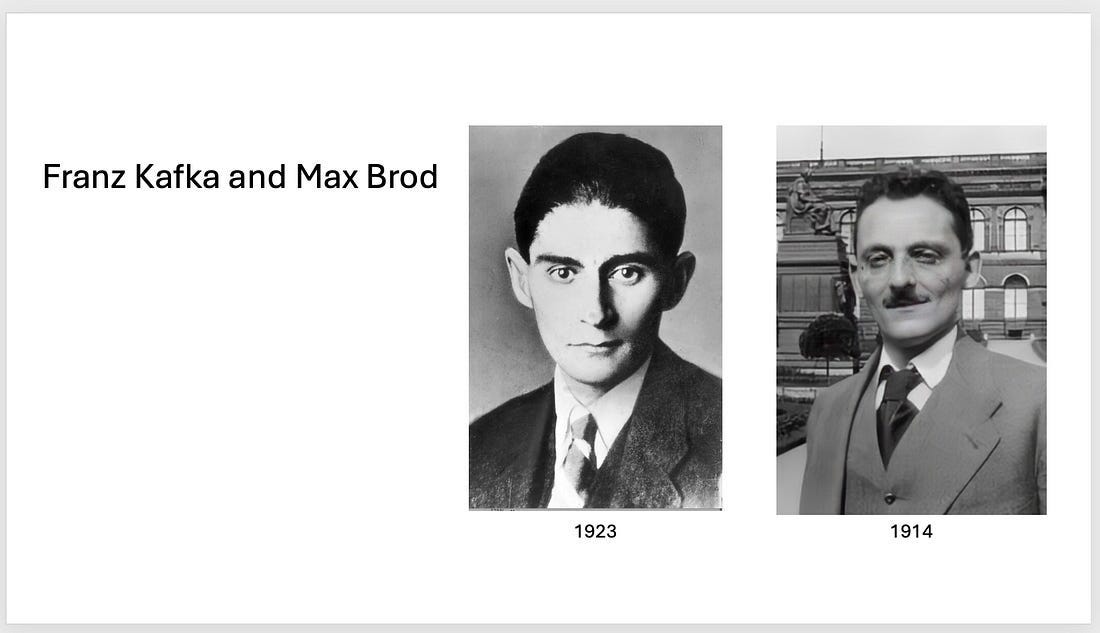
Good evening! I come to you today as a lover, not an expert. (I am not a Kafka expert.) Some years ago, when I was working as a journalist, I had an encounter with Kafka and Brod that has stayed with me. It’s something I’ve been returning to in my writing, now that I am mostly a novelist. So what a joy and honor to get to work through these ideas here with you today, at the Jewish Museum in Prague (thanks to organizers, hosts, translators).
In 2010, I got a call from the New York Times magazine, asking me to go to Israel to report on the legal case surrounding Max Brod’s papers. I won’t go into the details of the case, which are familiar to many of you, but here is an infographic with a chronology.
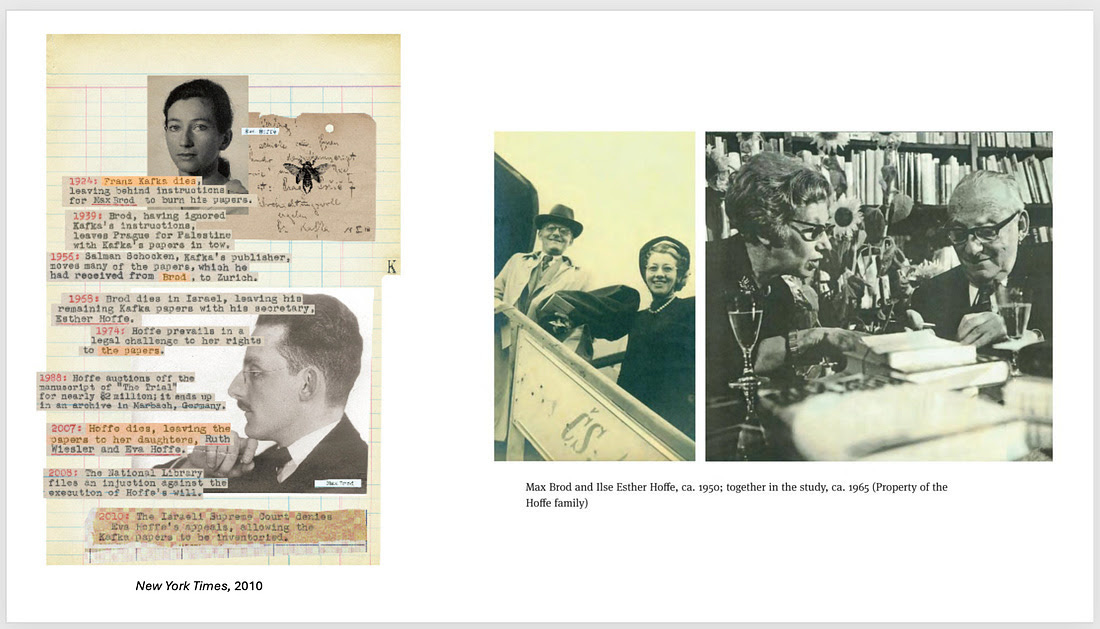
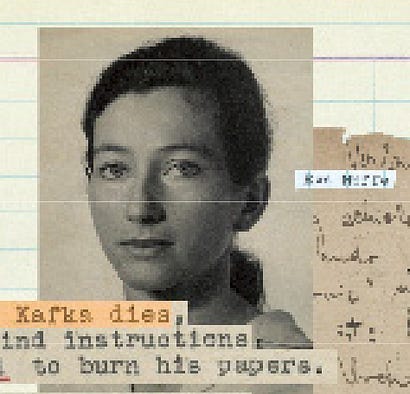
Just to quickly sum up: in 1921, Kafka writes a letter naming Brod as his literary executor, instructing him to burn everything. When Kafka tells him about the letter, Brod replies that he won’t comply with the instructions. Kafka doesn’t name a new executor.
In 1924, Kafka dies. Brod starts editing and publishing the works, starting with The Trial in 1925.
In 1939, Brod flees the Nazi occupation of Czechoslovakia. He ends up in Tel Aviv, where he meets Esther Hoffe, his soon-to-be secretary. After Brod’s wife dies, Brod becomes very close with Esther and her husband, Otto. He goes on vacations with them in Switzerland. Esther has an office in Brod’s apartment.
Brod dies in 1958, leaving the papers to Esther Hoffe. Esther eventually auctions off the manuscript of The Trial for nearly $2 million. It ends up in Germany, at the Marbach archive.
When Esther dies in 2007, she leaves the rest of Brod’s papers to her daughters, Eva and Ruth. The National Library of Israel challenges the legality of the bequest. In 2010, the Supreme Court of Israel rules that an inventory must be taken of all the papers, some of which are still at Eva Hoffe’s home, on Spinoza Street in Tel Aviv.
Eva Hoffe at this point has a lot of cats. This is where I get involved. Basically what I’m told by by the Times in 2010 is: “So the daughter lives in an apartment with 100 cats, and she doesn’t talk to anyone. But we’re hoping she’ll talk to you.”
I was just getting started as a writer, so I took the assignment, even though I don’t speak Hebrew or German (so even if Eva Hoffe wanted to talk to me, how was it supposed to happen?). The travel budget was tiny—I don’t remember exactly, something like $2000, almost all of it went to the plane ticket from San Francisco. I didn’t have enough for a hotel. I stayed at a friend’s friend’s aunt’s (?) apartment. [I was lucky to have such a brilliant and helpful friend.]
I spent several days running around Tel Aviv and Jerusalem, feeling continually guilty about my lack of qualifications. I was talking to scholars, archivists, and especially lawyers. An incredible number of lawyers. Eva Hoffe had a lawyer, the National Library had a lawyer, the Kafka estate had a lawyer, even the Marbach archive had a lawyer.
In the downtime from talking to lawyers, I lurked around Spinoza Street, hoping to somehow communicate with Eva Hoffe. I brought toys for the cats. Some of the cats came out, they were ready to go on the record, but Eva never answered the door.
Then I went back to SF and spent the whole summer writing the story. Meanwhile, the Times sent an Israel-based photographer (Natan Dvir) to Spinoza Street, and he had a really different experience from me: Eva invited him inside for tea and he was able to take a beautiful photo of her, and she even shared some old personal photographs. The story, “Kafka’s Last Trial,” made it to the cover:
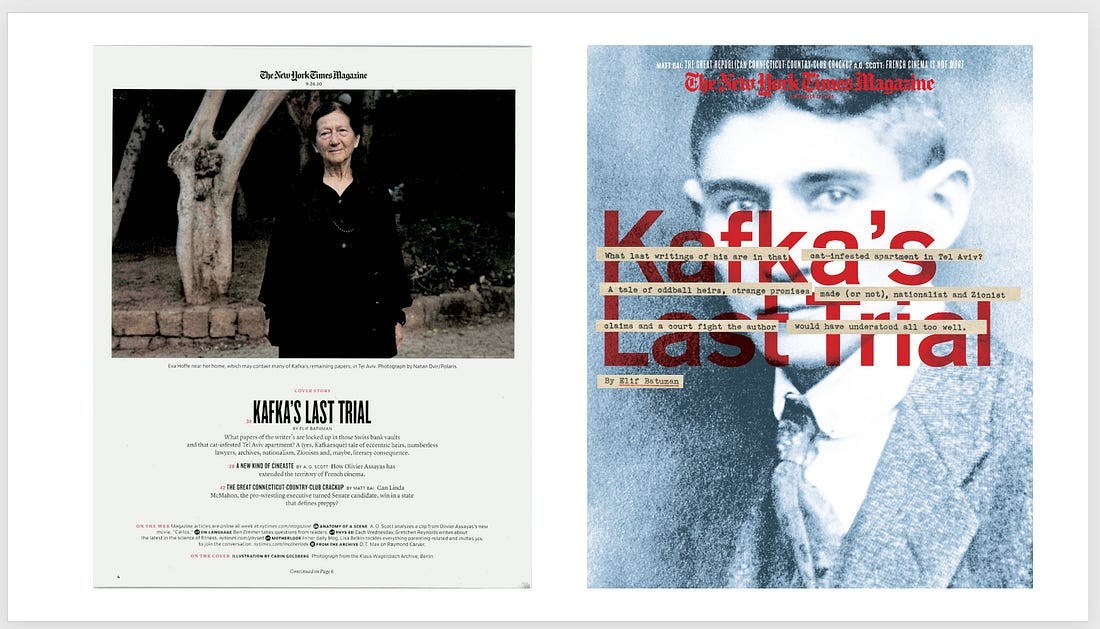
[NB I didn’t mention this in the talk, but actually one of the photos Eva shared was of herself as a young woman—I think from the time when she worked as an attendant for El Al—and it’s reproduced in the chronology infographic from the second slide.]
That was in September, 2010. The trial, as you know, lasted for many more years. In 2016, the Israeli Supreme Court ruled in favor of the National Library of Israel. Then there was another trial in Switzerland, but we’ll just fast-forward past that one. Since 2019, everything is at the NLI. And that’s it for the court case! Now we can talk about the actual human relationships!
Everyone who loves Kafka, has to be grateful to Brod. Literally everything we know of Kafka, all of his writing, comes to us via Brod.
But is gratitude always a pleasant feeling?
In 2010, when I was doing all the interviews, I kept encountering ambient waves of animosity towards Brod. Some of the animosity was relatively overt and pragmatic, and was related to how this whole legal mess had been caused by Brod—why hadn’t he put the papers in an archive, instead of leaving them to his secretary?
But there was also a less clearly stated, more emotional, and more diffuse annoyance at Brod—for getting in the way of “our” relationship with Kafka. And that’s one of the questions I want to ask today: What does it mean to try to get past Brod—to get to the authentic, unmediated Kafka?
In some cases, there is a clear literal answer. We heard yesterday from Ross Benjamin, the heroic translator who, at great personal cost, did Anglophone Kafka fans the huge service of translating the diary Kafka actually wrote, instead of the version redacted by Brod. In situations like this, it’s not just possible, but also very meaningful, to get past Brod. But I think such cases are more limited than we think.
I want to point out that Western literary culture has a model of authorship that’s very individual-oriented.
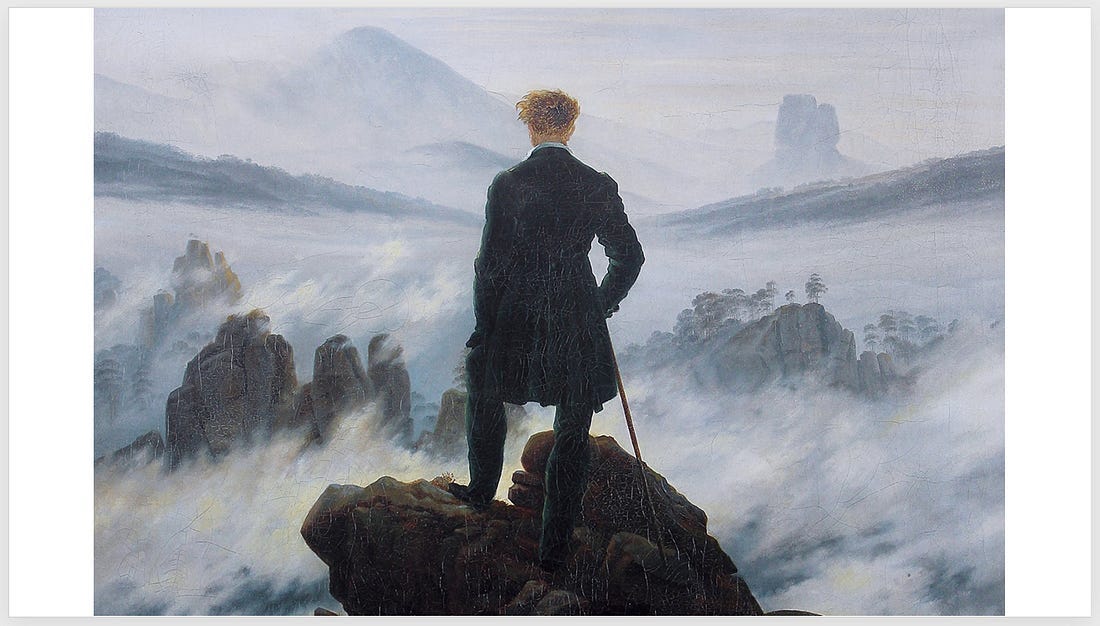
We still have the German Romantic idea of the artist as a lone individual. And it’s not that this idea is wrong, exactly: a big part of writing really is you alone in a room with your awful self. But it’s not the whole picture.
I want to read you what I think is a very insightful observation from Brod. “Two opposite tendencies fought for supremacy in Kafka: the longing for loneliness, and the will to be sociable.”
This is a central tension, not just in Kafka, but in the act of writing. We find it stated very clearly in Proust. (One thing I love about Brod’s Kafka biography is the weight he gives to biographical and psychological similarities to Proust.)
At the end of In Search of Lost Time, we learn that literary “work” is a product of solitude and darkness—AND that the work is co-authored by others, by people outside of ourselves. Every novel is a collaboration with real people—with real life.
This is the main question of my talk: what happens when we look at the Kafka-Brod relationship as a collaboration? Just to clarify, I mean this in a very moderate sense—I’m not saying it’s an equal collaboration. Or only a collaboration. But what do we learn when we look at the relationship as, among other things, a collaboration?
One place where the monologic idea of authorship is very evident in our culture, is when it comes to Famous Quotes. We tend to visualize them as pure emanations from the brain of the solitary author.
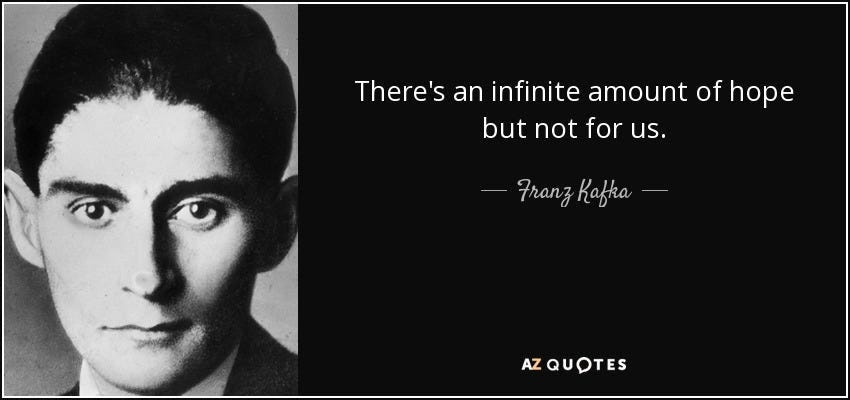
This is a paraphrase of a quote we all know. Speaking for myself, I think it’s represented in my brain much like it is visualized here—floating in black space next to a photo.
In fact, that quotation comes, not from anything Kafka wrote alone in a room, but from a conversation with Brod. It’s in Brod’s biography. Kafka tells Brod that he thinks humans are “nihilistic thoughts that came into God’s head.” Brod, trying to be helpful, quotes a Gnostic doctrine about how the human world is a sin committed by God. Kafka replies, basically: let’s not exaggerate, “we are not such a radical relapse of God’s, only one of his bad moods. He had a bad day.” Brod is encouraged: “So there’s hope, then, outside of our world”—and that’s when Kafka says it: there’s infinite hope, but not for us.
Yesterday, when I told Merve I was going to talk about Kafka’s relationship with Brod, she told me about a new German Kafka miniseries, where each episode focuses on some other person important to Kafka, and the first episode is a Max Brod buddy comedy. Within like thirty seconds she had sent me the link.
As I watched, I was thinking about the formal challenges of TV or film adaptation: e.g., you have to dramatize all the non-narrative ideas. All the content has to be delivered as a scene or a conversation, and sometimes this can create a feeling of artificiality or stiltedness.
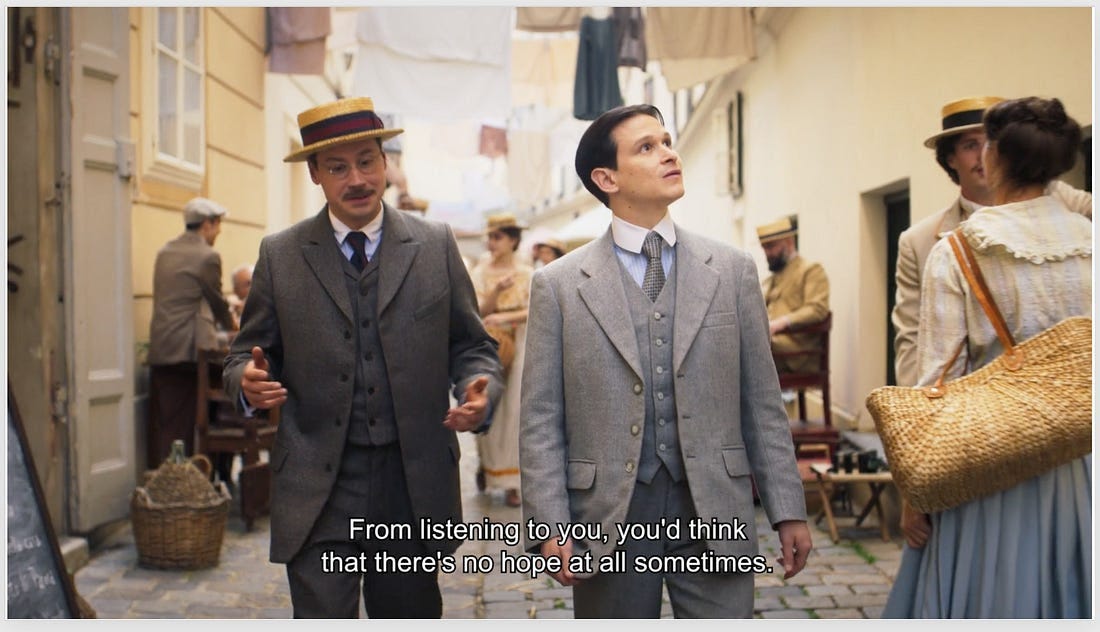
So here we see Brod and Kafka on vacation in Italy. Brod has just bought that straw hat. They’re chatting casually… and Brod tees up Kafka’s famous quote. And this made me think about how, maybe more often than we think, a seemingly monologic utterance is actually getting restored to its dialogic origin.
We could argue that the TV version of this line is more accurate than the disembodied quote, because it restores the element of dialogue, of tension, of argument.
One of the main arguments between Brod and Kafka, as we know, is about Zionism—and, relatedly, the religious interpretation of Kafka’s work. Brod embraces Zionism in 1912—the same year he helps Kafka publish his first book. From the beginning, Brod is determined to see Kafka as a religious, moral (and eventually Zionist) thinker—not primarily as an artist. This becomes very controversial for Kafka’s readers.
In his review of Kafka’s first book, Brod writes: “How much absoluteness and sweet energy emanates from these few short prose pieces… It is the love of the divine, of the absolute that comes through in every line… not a single word is squandered in this fundamental morality.”
This isn’t what we would call a consensus interpretation of Kafka. It’s pretty niche. It’s gushing, it’s lacking in nuance—it’s not tasteful. Kafka found it embarrassing. (We know this from a letter to Felice Bauer.)
This gushing interpretive tendency in Brod doesn’t diminish with time. In 1928, four years after Kafka’s death, Brod publishes a novel, The Enchanted Kingdom of Love, which includes a character named Richard Garta—a “saint of our day,” a fervent Zionist. Brod is very open about basing this character on Kafka.
Nine years later, when Brod writes the actual Kafka biography, he draws, again very openly, from the descriptions of this saintly fictional character, Richard Garta. He describes Kafka as someone who is, if not literally a saint, then on the way to becoming one.
So, unsurprisingly, Brod’s critics say: “This isn’t biography, it’s hagiography.” Brod is seen as gauche, tendentious, vulgar. He’s accused of turning Kafka’s works, which are SO multivalent—if there’s one defining feature, it’s plurality of meaning—into a mouthpiece for his own political agenda.
One critic who expresses this critique very emphatically is Milan Kundera.
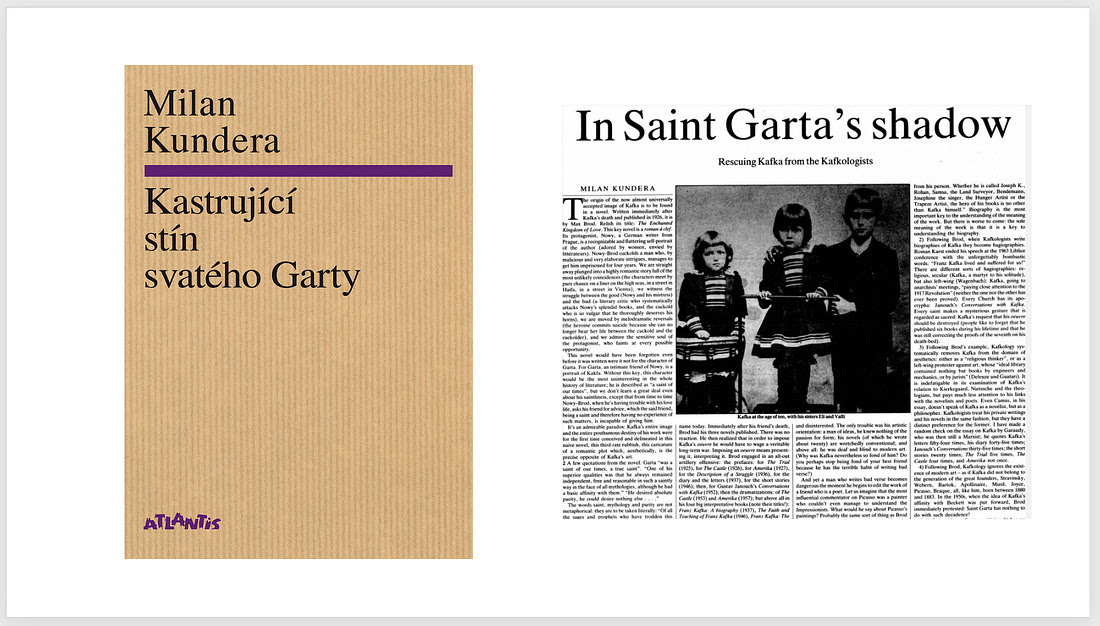
Here we see Kundera’s book titled, in Czech, “The Castrating Shadow of Saint Garta.” Ironically, that title is itself “castrated” by the TLS, where it becomes “In Saint Garta’s shadow.” (Later, the same essay is republished in an English-language collection with an even more tasteful title: Testaments Betrayed.)
Kundera’s goal in this essay is to “rescue Kafka from Brod.” Kundera does grant Brod many fine qualities. Brod is brilliant, selfless, loyal—but he doesn’t, according to Kundera, understand Kafka. This is because Brod is a man of ideas—fundamentally anti-literary, anti-artistic.
Characteristically, Kundera is particularly outraged that Brod deletes the passages in Kafka’s diary about visits to prostitutes. He says that “Kafkologists,” following Brod, make Kafka “hysterical,” “the patron saint of anorexics.” (OK he doesn’t say “effeminate,” but I mean, he does say “castrating.”)
Again, this is kind of a special Kundera take. But the more general sentiment—“I will never get to the bottom of the Brod mystery”—is widely shared.
In 1938, Walter Benjamin famously writes: Kafka’s “friendship with Brod is to me above all else a question mark which he chose to ink in the margin of his life.” Of all the mysteries about Kafka—how could he choose this guy as his best friend. This is a from a letter to Gershom Scholem in 1938. Benjamin has just read Brod’s biography, and his take is: “Brod has been denied any authentic vision into Kafka’s life.”
I was familiar with the criticism before I actually read Brod’s biography for the first time, in Tel Aviv. I was unprepared for how moving I found it. I cried multiple times. The treacly story that isn’t moving when it’s about Richard Garta, in The Kingdom of Love, is moving when it’s juxtaposed with the historic Kafka—with Kafka’s actual words, which are so un-treacly.
And the reason we have those words, is because Brod wrote them down. Brod realized, from the first night he met Kafka, when he was 18 and Kafka was 19, “I have to write down everything this person says.”
Brod and Kafka meet in 1902 at the German students’ union at Charles University. They’re both law students. Brod has just given a bombastic speech about Schopenhauer, in which he calls Nietzsche a “swindler.” And Kafka comes up to him afterwards. It’s interesting that Kafka approaches Brod first. And Kafka, who is so self-effacing—“deeply unobtrusive,” as Brod puts it, in his dress and demeanor—nonetheless remonstrates with Brod for “the extreme uncouthness of [his] way of putting things.”
This is exactly what Walter Benjamin finds so irritating about Brod: “his striking lack of tact,” his tendency towards “feuilletonistic clichés.” And yet it seems that this very “uncouthness”—which may relate to Brod’s famous “vitality”—is part of what attracts Kafka.
So Brod and Kafka are walking home together, talking about their favorite writers. Brod quotes a line he loves from Gustav Meyrink, comparing butterflies to “great opened-out books of magic.” Kafka responds by quoting a phrase from Hoffmannsthal: “the smell of damp flags in a hall.” He then falls into a deep silence, “as if this hidden, improbable thing must speak for itself.” And this is such an important moment for Brod that, thirty-five years later, he still remembers the street they were walking on, the house they were passing.
Brod starts collecting all of Kafka’s utterances. A lot of the most famous Kafka lines come to us from Brod’s biography. “My head made an appointment with my lungs behind my back.” A lot of hits. So the claim that Brod didn’t understand Kafka, or didn’t appreciate him, or wasn’t sensitive to him—it doesn’t quite hold up. Of course, in every relationship there are blind spots and misunderstandings. But “our” understanding of Kafka is largely an understanding that was communicated to us by Brod. Can we really say it was totally unavailable to Brod himself?
Brod DOES come across as pushy and tendentious—even, or especially, in the biography. We see Brod subjecting Kafka to Gustav Meyrink quotes, hounding him to visit publishers. We see that sometimes this is too much for Kafka. The biography actually reproduces many beautiful, tactful notes that Kafka writes, to get out of meeting Brod. My favorite:
My Max,
I am in such a bad way that I think I can only get over it by not speaking to anyone for a week, or as long as may be necessary. From the fact that you won’t try to answer this postcard in any way, I shall see that you are fond of me.
Your Franz
I remember reading that in Tel Aviv and having this realization that everything we know—even the picture of Brod as a bumbling oaf—comes from Brod himself.
It’s a kind of “Usual Suspects” moment that isn’t uncommon among people who study the fate of the Kafka papers. One scholar told me about a nagging suspicion that Brod himself had composed all of Kafka’s work—that Brod, perhaps, wrote two kinds of books: the conventional ones that he published under his own name, and then some that were so strange that he attributed them to a reclusive friend who worked at the insurance office. Is it possible to see such fantasies themselves as a collaboration between Kafka and Brod, maintained by Brod after Kafka’s death?
In 1927, Brod’s biography appears in the first edition of Kafka’s collected works, which is edited, of course, by Brod. The first volumes come out with Schocken, and then in 1935 the Nazis ban publication of the rest of the works in Germany, and the final volumes are published here in Prague. The last volume is Brod’s biography. The way the books are designed—the biography is indistinguishable from Kafka’s actual works.
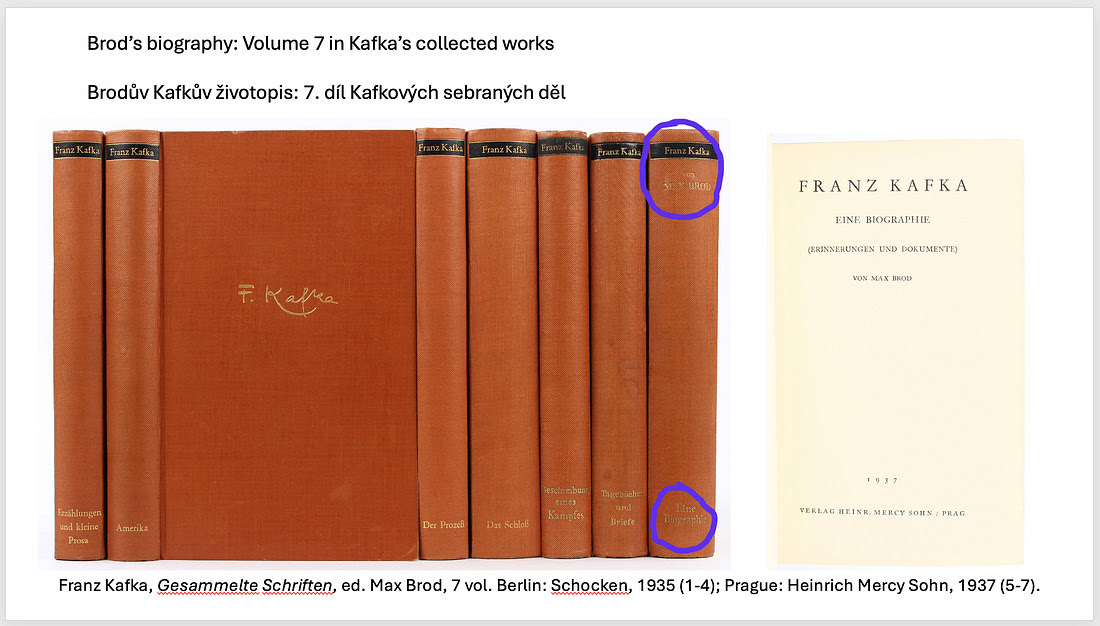
There’s a way this design decision can be seen as gauche, or even sinister. And there’s a way of seeing it as hilarious. They both have elements of truth.
We can see it as something that’s done to Kafka, against his will. Kafka obviously did not weigh in on the design of his own posthumously published works; insofar as he did weigh in, he clearly said that he didn’t want it published. And yet we have the fact that Kafka knew Brod very well, that Brod wasn’t exactly a subtle secret operator who was good at hiding his intentions. And Kafka chose Brod, and put up with him for some reason—for some series of reasons. And I think one of those reasons is related to humor. To the construct of “Funny Kafka.”
As we all know, there are many different Kafkas. One of them is Funny Kafka. And funny Kafka is very much in conversation with Brod. In the biography, Brod famously recounts how he and their friends laugh “quite immoderately” when Kafka reads them the first chapter of The Trial; Kafka himself “laughed so much that there were moments when he couldn’t read any further.”
Let’s linger for a moment on that image: Kafka, reading his work aloud to Brod and their friends, laughing too hard to keep reading.
And let’s turn back to Walter Benjamin—to the “question mark” represented by Brod, in the life of Kafka. That quote is from a 1938 letter from Benjamin to Gershom Scholem. “The friendship with Brod is to me above all else a question mark.”
In another letter to Scholem, written several months later—in February, 1939—Benjamin writes:
More and more, the essential feature in Kafka seems to me to be humor. He himself was not a humorist, of course. Rather, he was a man whose fate it was to keep stumbling upon people who made humor their profession: clowns. Amerika in particular is one large clown act. And concerning the friendship with Brod, I think I am on the track of the truth when I say: Kafka as Laurel felt the onerous obligation to seek out his Hardy—and that was Brod. However that may be, I think the key to Kafka’s work is likely to fall into the hands of the person who is able to extract the comic aspects from Jewish theology.
Benjamin’s 1939 “question mark” gets quoted a lot… more often than the answer, from 1938.
[I first encountered the Laurel and Hardy quote in Dimitris Vardoulakis’s 2010 book, The Doppelgänger: Literature’s Philosophy, which argues that, “from the perspective of Kafka’s writings, Brod can be regarded precisely as [Kafka’s] doppelgänger.”]
It isn’t hard to see what Benjamin means when he says Kafka is “not a humorist,” or not primarily a humorist: Kafka’s works are wrenching and terrifying. And yet… it’s possible to be humorous about situations that are wrenching and terrifying. It’s possible to argue that such situations are the origin of humor.
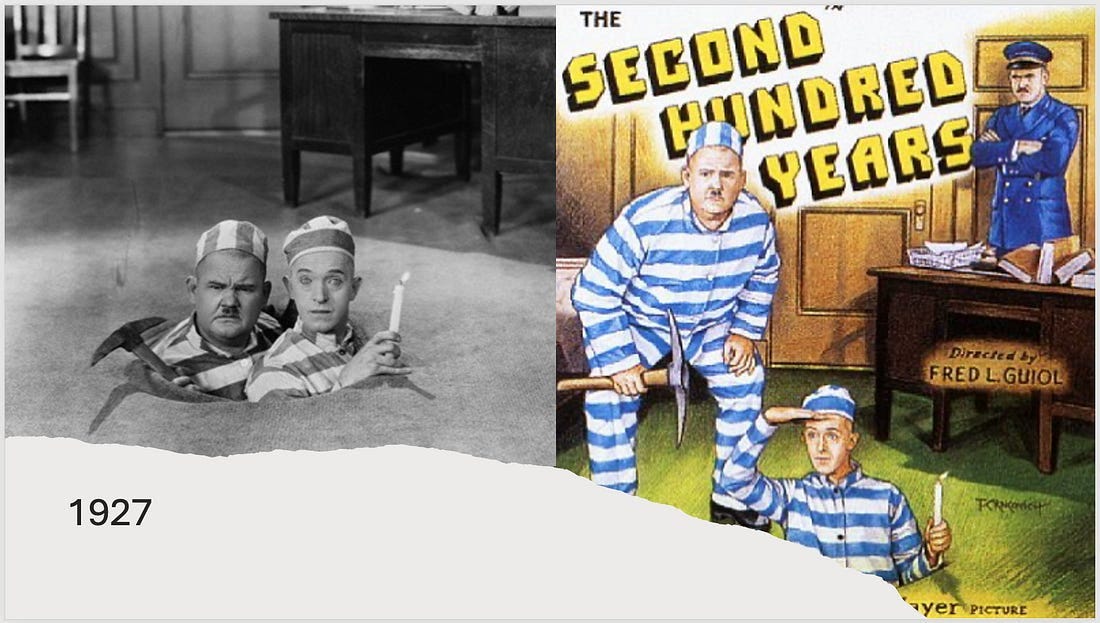
[Something now feels very true and somehow Buster Keaton-like to me about this image of non-humorist Kafka whose “fate” is to keep stumbling on clowns.]
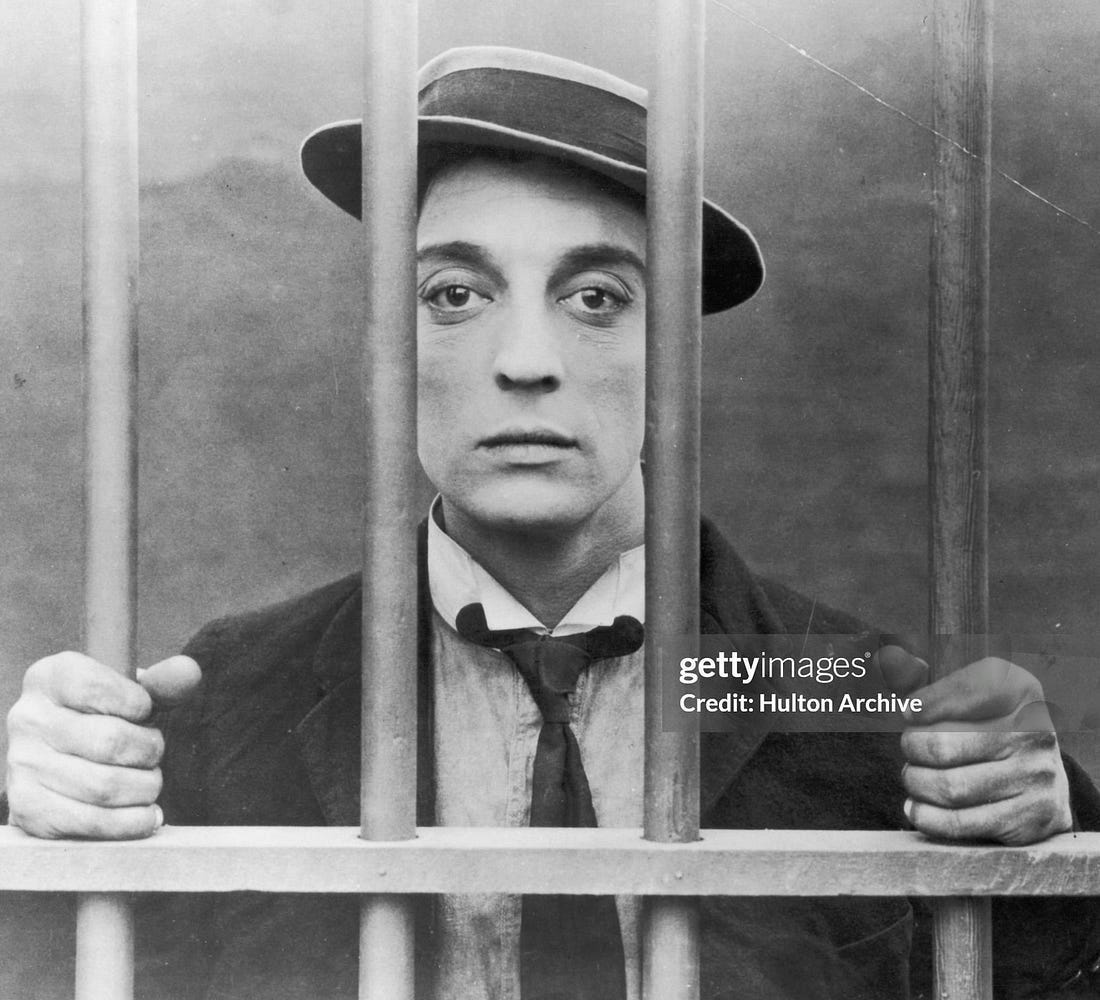
I want to read you also a brief a passage from Volume 1 of Reiner Stach’s biography of Kafka—from the part about Kafka and Brod’s vacations. Everything about these vacations is hilarious. At one point, Stach describes how Kafka and Brod are on a train in Italy, in a huge hurry to get to Paris—they’re behind schedule, as usual, thanks to Kafka’s inability to rush through anything. They’re planning to go straight to France, without getting off the train at all anymore in Italy. But it’s so hot, and at some point they see Lake Maggiore from the window, and it’s just too beautiful. They get out of the train and spend two days swimming. Stach writes: “Their relief was so palpable that they embraced while standing in the water—which must have looked quite odd especially because of the difference in their heights.” (Kafka is unusually tall, Brod is short.) They make a true comic duo. And I think that image, which Stach calls a scene of relief—it’s also a scene of love.
I was really hoping to see this scene in the new Kafka miniseries. But they cast kind of a short actor to play Kafka, and the Brod actor looks a bit taller, so they didn’t go for the embrace. But we do get Kafka and Brod on the train.
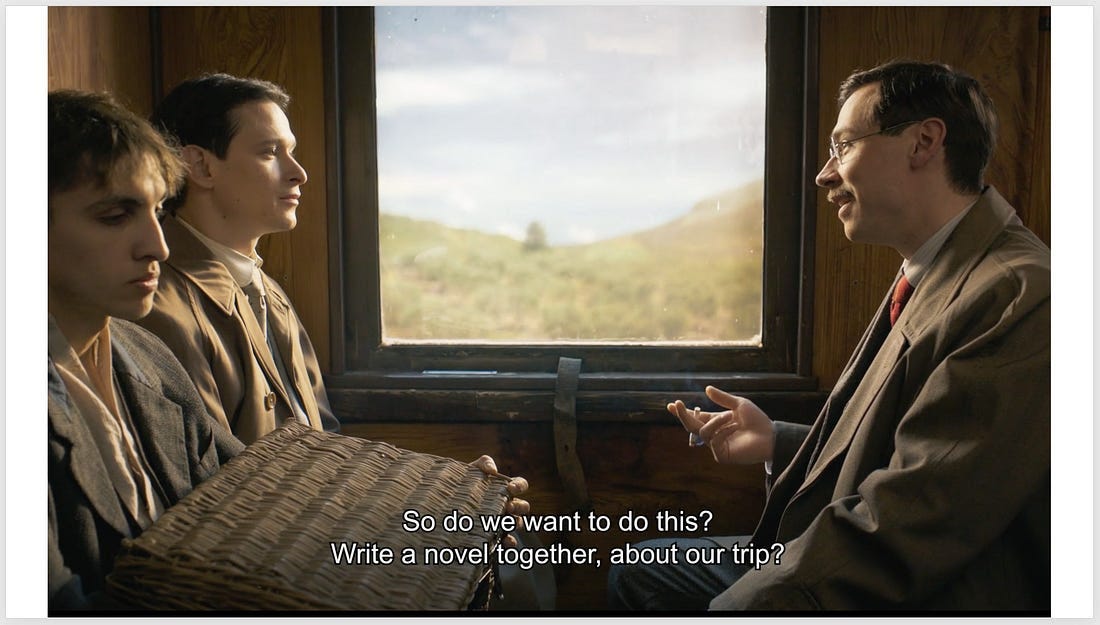
Another biographic fact: the comic vacation in Italy is when Kafka and Brod most explicitly try their hand at literary collaboration. They write parallel accounts of an airplane exhibition in Breschia. They draw up plans for a budget travel guide series. And they decide to co-write a novel. Richard and Samuel.
They write one chapter. And Kafka can’t keep it up. Because Brod is really a terrible novelist. It’s too many compromises for Kafka. They can’t actually write a book together.
But even if the literal collaborations don’t go anywhere, I want us to think about how, less literally, Kafka and Brod are constantly collaborating.
They start keeping diaries at the same time, in 1909. (Stach speculates about whether Kafka got the idea from Brod, or vice versa.)
In 1912, Brod drags Kafka to Leipzig—the capital, at the time, of German publishing—to meet Kurt Wolff, who ends up publishing Kafka’s first book. In an essay written many years later, Wolff recalls the almost grotesque impression left by Brod’s pushiness (“the impresario… presenting the star he had discovered”) and its effect on Kafka:
Oh, how he [Kafka] suffered. Taciturn, ill at ease, frail, vulnerable… he was sure he could never live up to the claims voiced so forcefully by his impresario. Why had he ever gotten himself into this spot; how could he have agreed to be presented to a potential buyer like a piece of merchandise!
In 1917, Kafka writes the story “A Report to an Academy”: a first-person testimony presented by an ape, or a former ape, to an academy of scientists. He recounts his own brutal abduction from the Gold Coast, his unimaginable sufferings on a ship to Europe. Over the subsequent five years, he manages to attain human status, working his way up from the ability to smoke, drink schnapps, and hobnob with his captors; to a career in the variety theater, and a life of banquets and scientific receptions.
There’s this incredible line: “With an effort which up till now has never been repeated I managed to reach the cultural level of an average European.” In a way, the story is about “an effort which up till now has never been repeated,” about an extreme, fantastic case. In another way it’s about the effort every person makes, starting from earliest childhood—the brutal sacrifices, the parts of ourselves we kill, to gain as much freedom as we can—and how we rationalize the ladder we’re climbing.
And, at least while he’s writing the story, Kafka is the ape. He’s paraded around by his impresarios, and he suffers—and then he achieves some kind of independence.
Kafka includes this story in his second book… which he dedicates to Brod. It’s published in 1919 by Kurt Wolff, who years later describes Brod as an impresario.
My point here is that we can see the living Brod-Kafka relationship working already as a comic routine, one that’s recognized, to some extent, by their contemporaries—and one that’s delivering serious, even shattering, content.
This brings me to my last point. I’d like to revisit Brod’s most contentious idea—Kafka as a Zionist saint—and think about whether we can see collaborative, even comic, elements here. Is it possible to see Brod’s idée fixe as a riff on some of Kafka’s work? Can we see some of Kafka’s work as a riff on Brod?
Brod leaves for Palestine in 1939, in a state of unspeakable grief—with the Kafka papers in his suitcases, vowing to start a Kafka archive and a Kafka club on the soil of Zion. His idea is that “the Hitler era, the era of destruction” will be followed by an age of “infinite creation in the spirit of Kafka.”
In pinning his hopes of a new world order onto Kafka’s work—a relatively small and abstruse body of literary fiction about animals and lawyers—Brod is following a dream logic practiced by Kafka himself. In Amerika, Karl believes that he can “have a direct effect upon his American environment” by playing the piano in a certain way. In “Josephine the Songstress,” Josephine’s singing—or whistling—is a direct response to the political-economic situation of the Mouse Folk: “It’s only through her songs that we are to be saved from all of the evil inherent in our political and economic reality, it’s nothing short of this that underlies her singing.”
The stakes in these works are so high, that the comic element can seem incongruous. We don’t quite accept it. To quote the narrator of “Josephine the Songstress”: “There’s an awful lot about Josephine that tends toward the comic”… and yet, “when Josephine comes before us we lose our capacity to laugh.”
But Kafka still has the capacity to laugh—even as he is addressing the most serious moral questions. Questions like: what kind of life is possible in a world so full of human-made and human-abetted suffering? Is there any conscionable way to exist in the hierarchy of power that we’re all born into?
This is a question with a lot of political significance, bringing to the coexistence of Funny Kafka and Political Kafka. I want to read you a quote from Deleuze and Guattari, from their Kafka book.
Kafka’s gaiety, or the gaiety of what he wrote, is no less important than its political reality and its political scope. The best part of Max Brod’s book on Kafka is when Brod tells how listeners laughed at the reading of the first chapter of The Trial “quite immoderately.” We don’t see any other criteria for genius than the following: the politics that runs through it and the joy that it communicates.
In other words, for Deleuze and Guattari, Funny Kafka is Political Kafka.
We actually find Walter Benjamin circling around this idea as early as 1934—in his notes for the essay he wrote on the tenth anniversary of Kafka’s death. Five years before the letter to Gershom Scholem, Benjamin is already comparing Kafka and Brod to Laurel and Hardy (and also to a popular Danish silent film duo, known as Pat and Patachon):
Kafka and Brod: Laurel sought his Hardy, Pat his Patachon. Offering God such entertainment made Kafka free for his work about which God did not have to care anymore… Perhaps [Kafka] had such a relation to Brod and his deep Jewish philosophemes like the relation between Sancho Panza to Don Quixote and his deeply meaningful chimeras of chivalry.
 | A guest post by
|