


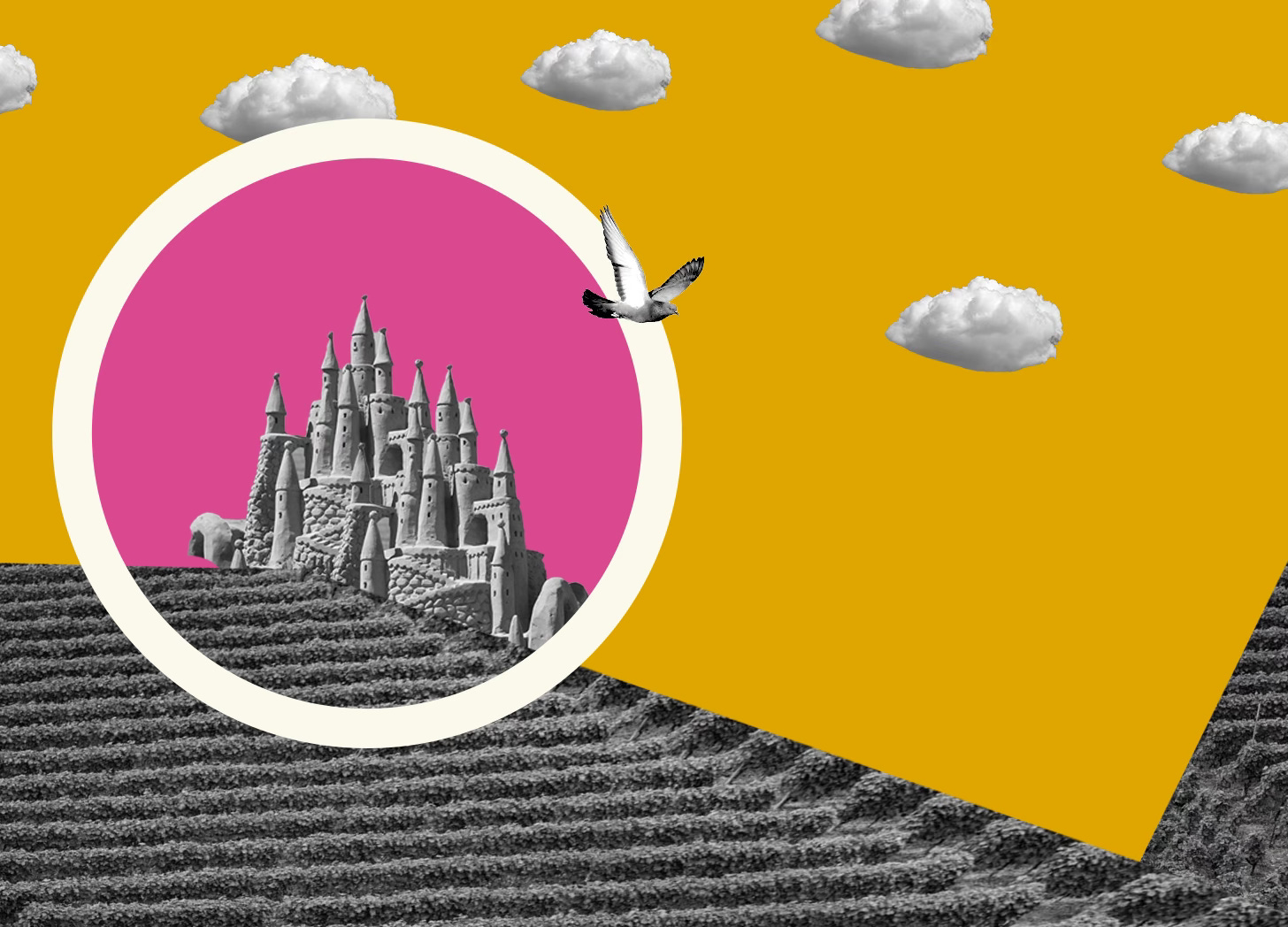
It’s a peculiar time I’m spending here, as you will have noticed by now, and I’ve needed such a peculiar time, a time in which I lie for hours on a vineyard wall, staring into the rain clouds that refuse to leave here or into the vast fields that grow even vaster when one has a rainbow in one’s eyes or where I sit in the garden telling the children (especially a small blonde six-year-old, whom the women call cute) fairy tales or building them sand castles or playing hide-and-seek with them or carving them tables that—God be my witness—never turn out well. Peculiar time, isn’t it?
Or where I walk through the fields, now standing there so brown and melancholy with the abandoned plows and yet lighting up so silver when, despite everything, the late sun comes and casts my long shadow (yes my long shadow, by which I just might make it into the kingdom of heaven) across the furrows. Have you ever noticed how late summer shadows dance on churned-up dark earth, how corporeally they dance. Have you ever noticed how the earth rises toward the feeding cow, how trustingly it rises? Have you ever noticed how heavy rich tilled earth crumbles under one’s all-too-delicate fingers, how solemnly it crumbles?
“vineyard wall”: See also letters #9 and #11.
Oskar Pollak: (b. Prague, 5 September 1883–d. Austrian-Italian front on the Isonzo, 11 June 1915) Oskar Pollak was a classmate of Kafka’s at the Altstädter Gymnasium. After completing his secondary education, he initially pursued studies in chemistry, later switching to philosophy and archeology, and ultimately to art history at Charles University. At the beginning of his studies, he joined the Lese- und Redehalle der deutschen Studenten (Reading and Lecture Hall of German Students), as did Kafka, whose closest friend he was during these early university years. In the summer semester of 1903 and in the winter semester of 1903–1904, Pollak served as art correspondent for the literary section of the organization. When he took a position as a private tutor at Oberstudenetz Castle at Zdiretz (Ždírec nad Doubravou) in the fall of 1903, Kafka succeeded him in this role. Pollak earned his doctorate in 1907 with a dissertation on the Baroque sculptors Johann and Ferdinand Maximilian Brokoff. That same year, he married Hedwig Eisner in Prague. Pollak authored numerous studies on art history, focusing primarily on the Renaissance and Baroque periods. From 1910 to 1913, he worked first as an assistant and, after completing his postdoctoral qualification, as a lecturer in art history at the University of Vienna. When he was offered the position of art history secretary at the Austrian Historical Institute in Rome, Pollak left Vienna and moved to Italy with his wife. With the outbreak of the First World War, Pollak volunteered for military service. He died on June 11, 1915, on the Austrian-Italian front during the early Battles of the Isonzo in Friuli.
English Translation Copyright © 2025 Ross Benjamin
This translation is based on Franz Kafka: Briefe. Kommentierte Ausgabe. Herausgegeben von Hans-Gerd Koch © S. Fischer Verlag GmbH, Frankfurt am Main 1999.
I have to say these letters, and this entire project, arrives in my inbox like bits of gold, sometimes I get to them and sometimes not, but when I do I am inspired and in awe of Kafka’s sudden, surprising use of language in even the most quotidian letters. Thank you.
Just the beauty of the line about his long shadow perhaps getting him into the Kingdom of God, how the shadows "corporeally dance," the earth rising trustingly towards the feeding cow. I don't think of Kafka as saying much about nature in his works, or, like Dostoevsky, appearing to be indifferent to it most of the time, but this letter shows another side of him. Exquisite.